






Types of E-Commerce: A Complete Guide to Models and Benefits
E-commerce lets you launch a business and reach customers anywhere. Discover the main types of e-commerce, how each model works, its benefits and challenges, and which one suits you.

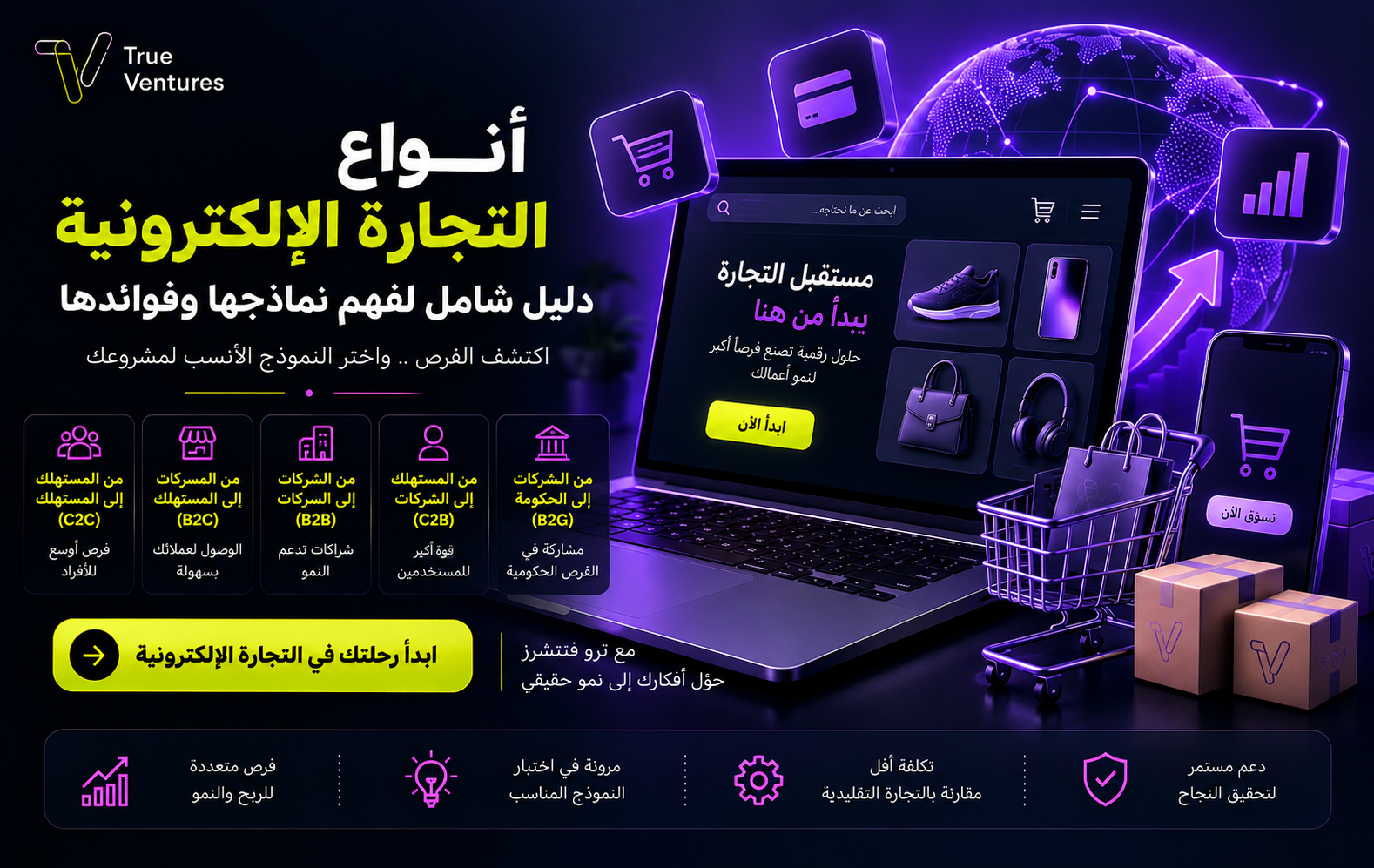
E-commerce has become the main gateway for launching a business and reaching customers without being tied to one location. This guide explains the types of e-commerce, the stages of building an online business, and the benefits and challenges you should plan for.
What Is E-Commerce?
E-commerce is the buying and selling of products or services over the internet. It covers every step of a commercial transaction: presenting and marketing the product, receiving the order and taking online payment, all the way to delivery and after-sales service.
E-commerce is not limited to stores that sell physical goods. It also includes digital services, subscriptions, learning platforms, software, bookings and marketplaces that connect sellers with buyers.
What sets e-commerce apart from traditional selling is its heavy reliance on technology, data and automation. Success does not depend on product quality alone; it is just as tied to store speed, ease of use, secure payment, effective marketing and the quality of the customer experience.
The Main Types of E-Commerce
The types of e-commerce are classified by the parties involved in buying and selling. Understanding each type helps you choose the right business model and define the kind of platform, audience and marketing approach you need.
1. Business-to-Consumer (B2C) E-Commerce
Business-to-consumer is one of the most widespread types: a company sells its products or services directly to individuals through an online store or app.
Examples include selling clothing, devices, personal care products, meals, training courses and digital subscriptions. Success in B2C depends on an easy checkout, fast delivery, multiple payment options, good customer service and trust.
2. Business-to-Business (B2B) E-Commerce
Business-to-business commerce happens when one organisation provides products or services to other organisations. It can involve selling raw materials, supplying equipment, or providing software solutions such as ERP and CRM systems.
B2B deals are usually larger in value and have a longer decision cycle, because they may require custom quotes, management approvals, contracts and technical integration between systems.
3. Consumer-to-Consumer (C2C) E-Commerce
In this model, individuals sell products or belongings to other individuals through an intermediary digital platform. It is most visible in the sale of used goods, handmade items and personal collectibles.
The platform’s role is to make listing products, communicating, and managing payments or ratings easy. Key success factors include protecting users, verifying accounts and setting clear dispute-resolution policies.
4. Consumer-to-Business (C2B) E-Commerce
Here, an individual offers a service, product or commercial value to a company. Examples include providing design, writing, photography or consulting services, or selling licences and digital content to businesses.
It also covers content creators partnering with brands, and users contributing ideas and designs that help companies develop their products.
5. Business-to-Government (B2G) E-Commerce
In B2G, companies provide technical and operational products or services to government entities through tenders and the dedicated platforms and systems used for them.
This type demands a high level of organisation, compliance with requirements, data protection, documented procedures and the ability to integrate with government systems.
6. Direct-to-Consumer (D2C) E-Commerce
In direct-to-consumer commerce, a brand sells its products to customers with no intermediary. This gives the company far more control over the buying experience, pricing, data and after-sales service.
The model also helps build a direct relationship with customers and use their behaviour to improve products and marketing campaigns.
7. Subscription E-Commerce
The customer pays a recurring fee to receive a product or service on an ongoing basis, such as software subscriptions, learning platforms, digital services and monthly bundles.
This model can generate recurring revenue, but it requires delivering continuous value that keeps cancellation rates low and customers loyal.
What Are the Stages of Building an E-Commerce Business?
E-commerce does not start and end with designing a store. It moves through several connected stages that determine whether the business can succeed and last.
Researching the Idea and the Market
The journey begins by defining the problem your business will solve, and studying the audience, demand, pricing and buying habits. The idea needs a clear value that makes customers choose your product or service.
Choosing Your E-Commerce Model
After researching the market, you choose the right type: will you sell to individuals or to businesses? Will you rely on physical products, digital services or subscriptions?
This decision shapes the platform design, the payment process, the order management system and the marketing plan.
Technical Planning and User Experience
This stage covers defining the project requirements, mapping the customer journey, and specifying the pages and features you need, such as search, filters, checkout, order tracking and an admin dashboard.
The clearer and shorter the user journey, the higher the chance of completed purchases.
Designing the Store or Platform
Interfaces are designed to reflect the brand identity while staying mobile-friendly, easy to read and quick to navigate to products.
The design should focus on helping customers make decisions, not on looks alone.
Development and Integrations
This stage includes building the store and connecting it to payment gateways, shipping companies, and inventory, invoicing and customer management systems. The platform must be secure and able to scale as orders grow.
Testing and Launch
Before launch, test site speed, registration, payment, notifications, device compatibility and data protection. Then launch the project and monitor performance so any issue is fixed quickly.
Marketing and Continuous Improvement
After launch, the work of attracting customers begins through SEO, content, advertising and social media. Data is analysed to identify sales sources, the points where users drop off and the most in-demand products.
What Are the Benefits of E-Commerce?
E-commerce offers advantages that make it a strategic choice for modern businesses, including:
- Reaching customers in many regions without opening multiple branches.
- Receiving orders around the clock.
- Lowering some operating costs compared with traditional expansion.
- Measuring sales and user behaviour accurately.
- Personalising offers based on customer interests.
- Simplifying inventory, order and invoice management.
- Testing new products and markets at a controlled cost.
- Building a database that supports better decisions.
- Supporting expansion and growth in the Saudi market and beyond.
These benefits do not happen automatically, though. They require a clear strategy, a strong platform and ongoing management of the customer experience.
E-Commerce Challenges and Risks
Despite the big opportunities, e-commerce businesses face a set of challenges you should prepare for from the start.
Protecting Data and Payments
Platforms can be targeted by hacking or fraud attempts if they are not built to strong security standards. That is why you must protect customer data, keep systems updated, manage access permissions and run regular security tests.
Rising Competition
Because stores are easy to launch, customers now have more alternatives than ever. Your business needs a genuine value proposition, a clear identity and a user experience that sets it apart.
Managing Shipping and Inventory
Inventory errors and late deliveries hit customer satisfaction directly. It is best to connect inventory, orders and shipping through one unified system that reduces manual work.
Shopping Cart Abandonment
Customers may add products to their cart and then leave because the site is slow, checkout is complicated or unexpected costs appear. You can reduce this by simplifying the steps and showing key information clearly.
Total Dependence on Technology
Any failure in hosting or the payment system can stop sales. Your store needs a stable infrastructure, backups and continuous performance monitoring.
Low Trust
Customers hesitate to buy when they cannot find enough information about products or exchange and returns policies. Trust grows with accurate descriptions, clear photos, reviews and responsive customer service.
Why E-Commerce Matters for Individuals
E-commerce has opened up many opportunities for individuals to shop, work and start businesses. It helps consumers compare products and prices and access a wider choice without visiting physical stores.
It has also enabled skilled people to sell their services and digital products and reach businesses and customers in different regions. Today, an individual can start a specialised business with carefully planned resources, then grow it based on sales results and market needs.
Success, however, requires choosing a clear niche, understanding your audience, offering a trustworthy experience and not relying on ads alone without building a strong brand.
Why E-Commerce Matters for Businesses
For companies, e-commerce is a complete growth channel, not just an extra way to sell. It helps an organisation build a permanent digital presence, reach new segments, connect marketing with sales and make better decisions with data.
Digital systems also allow companies to automate repetitive tasks, organise orders, manage customers and connect departments with one another. The impact of e-commerce grows when the platform integrates with ERP, CRM, inventory and reporting systems.
A scalable platform gives a company more freedom to launch new products, enter different markets and improve the user experience without rebuilding the project from scratch.
Tips for Building a Successful E-Commerce Business
- Define your audience and the problem your product solves before you start designing.
- Choose your e-commerce model based on your customers and sales cycle.
- Make the buying experience clear and fast on mobile.
- Use original photos and descriptions that answer customer questions.
- Make prices, delivery and exchange policies clear before payment.
- Connect your store to inventory, customer and reporting systems.
- Test performance and security before and after launch.
- Track your conversion rate, average order value and customer acquisition cost.
- Develop your platform based on data, not guesswork.
Start Your E-Commerce Business With True Ventures
The many types of e-commerce give every business the chance to pick the model that fits its audience and goals. But turning an idea into a successful platform takes careful analysis, a professional user experience, secure development and a measurable growth plan.
With True Ventures, you move from an idea to a working digital product that is ready to scale and attract investment. Our methodology starts with understanding your business model and defining requirements, then designing the experience, developing and testing the platform, through to launch, follow-up and data-driven performance improvement.
With expertise in systems and platform development, mobile apps, user experience, enterprise solutions and digital growth services, True Ventures builds solutions that fit the Saudi market and are ready for future growth.
Talk to True Ventures today and start building a powerful e-commerce platform that turns your idea into a real business with lasting value.
FAQs About the Types of E-Commerce
What are the most common types of e-commerce?
The most common types are business-to-consumer (B2C), business-to-business (B2B), consumer-to-consumer (C2C) and consumer-to-business (C2B).
What is the difference between B2B and B2C?
B2B targets businesses and usually involves larger deals and a longer sales cycle, while B2C targets individuals and relies on faster buying decisions and a simple shopping experience.
Which type of e-commerce is best for beginners?
It depends on the product, the audience and the budget. An individual might start by selling digital services or specialised products, provided they research demand and set a clear operating and marketing plan.
Do you need an online store to do e-commerce?
Not in every case, but owning your own store or platform gives your business far more control over its identity, data, customer experience and sales operations.
What are the key success factors in e-commerce?
A clear idea, a product people want, ease of use, secure payment, a fast platform, efficient shipping, good customer service and continuous data-driven improvement.
How do you choose the right company to build an e-commerce platform?
Look for a company that starts by analysing your business model, cares about user experience, security and scalability, and follows a clear methodology covering design, development, testing and post-launch support.
Can an online store be expanded in the future?
Yes, as long as it is built on a flexible technical architecture that allows new products, features, branches and integrations to be added without hurting performance.
Turn this guide into a plan.
Tell us where you are today. Our team will map the next steps with you.
The quickest way
Have a question? Ask us on WhatsApp.
Tell us what you are planning and our team will point you to the right people — no form to fill in.
We usually reply within minutes during working hours.