



Types of Digital Marketing: How to Choose the Right Strategy in 2026
The answer is not one channel. Explore the main types of digital marketing, from SEO and paid ads to content, social media and email, and learn how to build the right mix for your business.

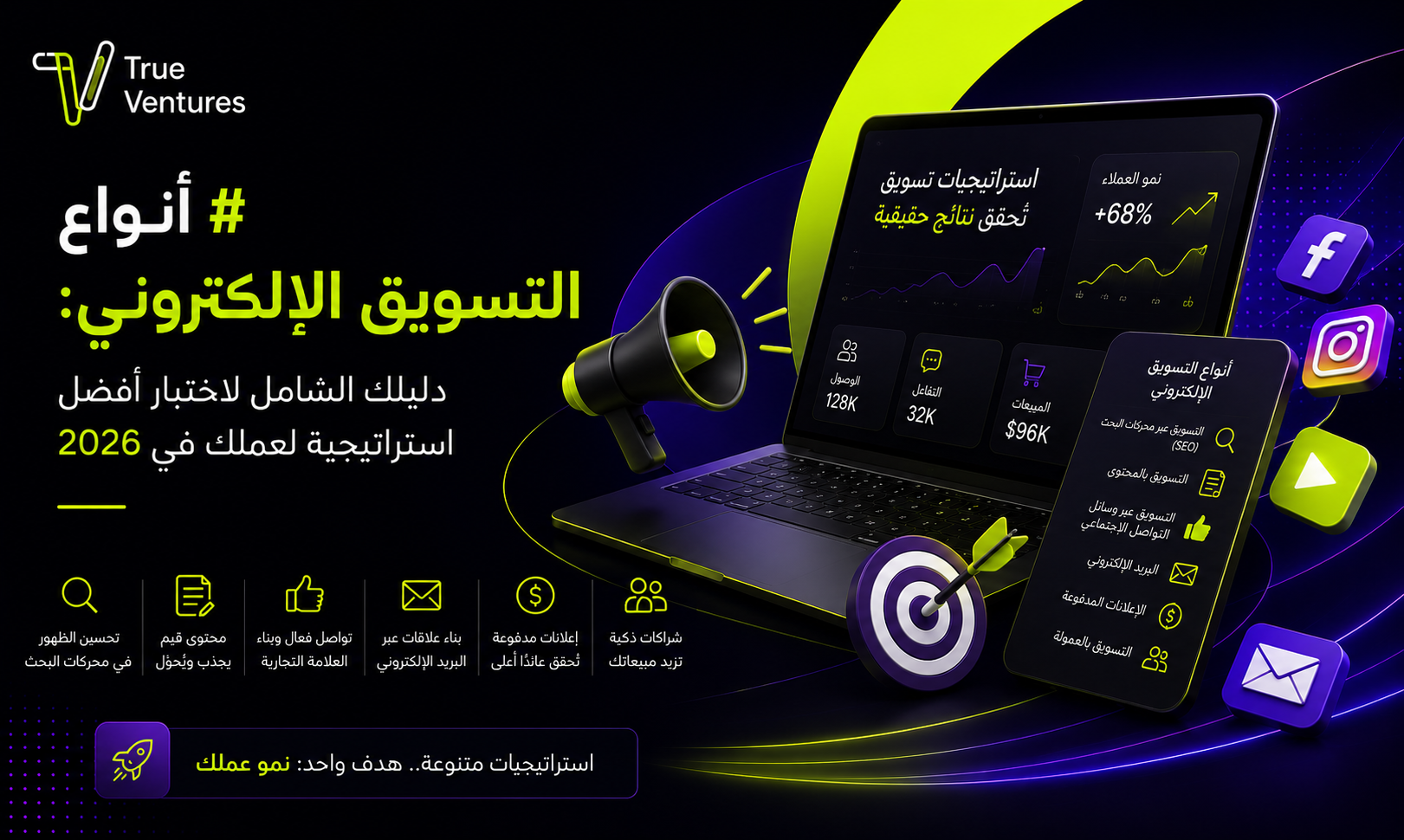
Choosing between the types of digital marketing is not about picking one channel and relying on it. Digital marketing has become an integrated system that brings together search engine optimisation, paid advertising, content marketing, social media, email, influencers and more.
In the Saudi market in particular, an integrated digital marketing strategy matters more than ever as people rely increasingly on the internet and digital platforms. DataReportal figures point to around 34.4 million internet users in Saudi Arabia by the end of 2025, a penetration rate of 99%, which shows the size of the opportunity for businesses that invest in their digital presence.
In this guide from True Ventures we walk through the most important types of digital marketing, the strengths of each one and how to choose the mix that best serves your business goals.
What Is Digital Marketing?
Digital marketing is the use of digital channels and technologies to reach your target audience, build awareness of your brand, attract potential customers and turn them into paying ones.
Its channels include search engines such as Google, social media platforms, websites, email, digital advertising and more.
Its biggest advantage is that everything can be measured.
Instead of launching a campaign without knowing its real impact, you can see how many people saw your ad, how many visits and leads it generated, how many sales it drove and what each customer cost to acquire.
What Are the Types of Digital Marketing?
The main types of digital marketing are:
- Search engine optimisation (SEO).
- Search engine marketing (SEM) and paid advertising.
- Social media marketing.
- Content marketing.
- Email marketing.
- Affiliate marketing.
- Influencer marketing.
- Video marketing.
- Mobile app marketing.
- Remarketing.
Knowing the names is not enough, though. What matters is understanding what each channel does and when to use it.
1. Search Engine Optimisation (SEO)
Search engine optimisation (SEO) is a set of practices that helps your website’s pages rank better in organic search results when people search for a topic or service related to your business.
Imagine you run a software company in Saudi Arabia and a client searches Google for “app design company in Saudi Arabia”. Appearing in front of them at that moment means you are reaching someone who is already interested in your service.
That is why SEO is one of the most important long-term digital marketing strategies.
It typically includes:
- Keyword and search intent research.
- Creating useful, in-depth content.
- Optimising headings and page structure.
- Improving site speed and user experience.
- Building internal links.
- Taking care of the technical side (technical SEO).
- Earning trustworthy signals and backlinks for the website.
When is SEO the right choice?
When you want to build a sustainable source of traffic and leads instead of depending entirely on paid ads.
2. Search Engine Marketing (SEM) and Paid Advertising
If SEO targets organic visibility, search engine marketing (SEM) relies mainly on ad campaigns to reach users through search engines.
Google Ads is the best-known example.
You could, for instance, run a campaign targeting people who search for:
“e-commerce website design”
or:
“app development company in Saudi Arabia”
You then pay per click, or according to whichever pricing model the campaign uses.
The main advantage of paid advertising is speed. You do not have to wait for your pages to climb the organic rankings before you start attracting visitors.
But successful ads depend on more than budget. They need precise targeting, the right keywords, persuasive ad copy, strong landing pages and continuous conversion tracking.
3. Social Media Marketing
Social media marketing means using platforms such as Instagram, TikTok, Snapchat, LinkedIn, X and others to build relationships with your audience and promote your products and services.
This channel is especially important in Saudi Arabia, where social platforms are hugely popular. Digital 2026 data, for example, shows that YouTube’s reported advertising reach in Saudi Arabia was around 27.5 million users in late 2025, while Snapchat’s reported advertising reach was around 25.3 million users. Bear in mind that advertising reach figures do not necessarily equal monthly active users.
That does not mean your company needs to be on every platform.
The better question to ask is:
Where are my customers actually spending their time?
A B2B company may find LinkedIn far more valuable, while a consumer brand may benefit more from Instagram, TikTok or Snapchat.
How to Succeed with Social Media Marketing
Define your audience persona, choose the right platforms, build a clear content plan, balance educational, engaging and sales content, then monitor your results continuously.
Do not treat follower count as your only measure of success. You could have 100,000 followers and no sales, while a smaller page delivers far better commercial results.
4. Content Marketing
Content marketing means giving your audience useful content to build trust, attract potential customers and move them gradually towards a decision.
That content can include:
- Articles and guides.
- Videos.
- Case studies.
- Infographics.
- E-books.
- Educational posts.
- Reports and research.
- Webinars.
The article you are reading right now is an example of content marketing: a user searches for the types of digital marketing, gets a comprehensive answer and, at the same time, discovers the expertise of the company providing it.
This is where the strong link between SEO and content marketing becomes clear: good content provides the material that search engines can discover, understand and show to users.
5. Email Marketing
Despite dozens of new channels, email is still a powerful tool for building a direct relationship with customers and prospects.
You can use it for:
sending offers, newsletters, educational content and welcome messages, winning back past customers, following up with leads and promoting new products.
The advantage is that you are talking to people who have already shown an interest in your brand.
Tip: Do not turn every email into a sales pitch. Offer real value so customers have a reason to keep opening your messages.
6. Affiliate Marketing
In affiliate marketing, a person or organisation promotes a product or service and earns a commission when a sale or another agreed action happens through them.
The model is widespread in e-commerce and digital services because it ties a large share of marketing costs to actual results.
A successful affiliate programme, however, needs accurate tracking, clear commission terms and partners whose audience fits the product.
7. Influencer Marketing
Influencer marketing is built on working with content creators and influencers to reach their audience and promote your brand.
Success here does not mean choosing whoever has the most followers.
In some cases, a micro-influencer with a small but specialised and engaged audience can deliver better results than a huge account whose followers have little connection to the product.
Before working with any influencer, assess the quality of their audience, their engagement rate, how well their content fits your brand and their past results, not just their follower count.
8. Video Marketing
Video has become a core part of digital marketing strategies, especially with the rise of YouTube, TikTok, Instagram Reels and short-form video.
You can use it to explain products, share customer experiences, present case studies, deliver educational content and show how a product is used.
9. Mobile App Marketing
If your business runs on a mobile app, the app itself becomes an important marketing channel.
Push notifications, personalised offers, loyalty programmes and user behaviour analytics can all increase engagement and customer retention.
But this strategy succeeds before the marketing even starts, with a great user experience and an app that is fast, stable and scalable.
This is where technology and marketing meet directly.
10. Remarketing
Have you ever visited an online store and then started seeing ads for its products?
That is one form of remarketing.
This strategy helps you reach people again who interacted with your business but did not complete the action you wanted, such as buying a product or submitting a service request.
It can be highly effective because the audience already knows your brand, but use it in moderation: manage ad frequency and respect privacy and the applicable consent requirements.
How Do the Types of Digital Marketing Compare?
No single type is the best choice in every situation.
Here is a simple way to compare them:
| Marketing Type | Main Goal | Type of Results |
| SEO | Attract organic search traffic | Long-term |
| SEM | Attract paid traffic quickly | Fast |
| Social Media | Awareness, engagement and reach | Ongoing |
| Content Marketing | Build trust and expertise | Medium to long-term |
| Email Marketing | Retention, follow-up and conversion | Ongoing |
| Affiliate | Grow sales through partners | Performance-based |
| Influencer Marketing | Reach and social proof | Short to medium-term |
| Remarketing | Win back potential customers | Relatively fast |
How to Choose the Best Types of Digital Marketing for Your Business
The most common mistake is to start with the channel:
“We want a TikTok account.”
“We want SEO.”
“We want a Google Ads campaign.”
The better approach is to start with your business goal.
First decide: do you want more sales? More leads? A new product launch? Greater awareness? Or better retention of existing customers?
Then define your audience, their digital behaviour, your available budget and how long you can wait for results.
In many cases, the best answer is a combination of channels.
For example:
SEO + Content + Google Ads + Remarketing
SEO and content can build a sustainable source of traffic, ads can deliver faster results, and remarketing campaigns can reconnect with users who did not convert on their first visit.
Technology and Marketing: Why You Need Both
You can run an excellent marketing campaign, but what happens when customers land on a slow website, a confusing page or a booking system that does not work?
You lose part of the return on your marketing.
That is why True Ventures treats digital growth as a single system in which technology is inseparable from user experience and business goals.
True Ventures is a Saudi technology company that enables digital transformation for businesses and organisations, combining technical expertise, an investment mindset and proven methods for analysing, designing and developing systems.
Its services include developing systems and digital platforms such as ERP, CRM and HR, mobile app design and development, user experience and digital identities, enterprise and government sector solutions, as well as digital growth services.
Its methodology moves through clear stages: it begins with analysis and a study of the business model, market and users, continues through design, development and testing, and goes all the way to launch, continuous improvement and the growth stage.
The Bottom Line: Look for the Best System, Not the Best Channel
Understanding the types of digital marketing is the first step, but real results begin when you know how to combine them into a single strategy that serves your business goals.
SEO gives you sustainable organic growth, ads give you fast reach, content builds trust, social media brings you closer to your audience and email helps you maintain the relationship, while remarketing recovers the opportunities that did not convert the first time.
Most importantly, all of these efforts need a strong digital foundation, a good user experience and continuous data measurement.
At True Ventures, we turn ideas into digital products and platforms built to grow, from analysis, design and development through to launch, optimisation and digital growth.
If you are planning to strengthen your digital presence or build a platform or app that supports your marketing plan, talk to True Ventures to discuss your project’s needs and build the right solution for your stage of growth.
Questions and answers
01What are the most common types of digital marketing?
The most common types are search engine optimisation (SEO), search engine marketing (SEM), social media marketing, content marketing, email marketing, affiliate marketing, influencer marketing, video marketing and remarketing.
02What is the best type of digital marketing?
No single type is best for every company. The right choice depends on your goal, audience, budget, the nature of your product and your business stage. In most cases, a strategy that combines several channels delivers more sustainable results.
03What is the difference between SEO and SEM?
SEO focuses on improving organic visibility in search engine results, while SEM, in its common marketing use, relies on paid campaigns to reach people who are searching. The two can work together instead of always being treated as alternatives.
04Is social media marketing right for every business?
It can benefit most brands, but the platform and strategy will differ. A B2B company, for example, may get more from LinkedIn than from other platforms, while a consumer brand needs different channels depending on its audience.
Turn this guide into a plan.
Tell us where you are today. Our team will map the next steps with you.
The quickest way
Have a question? Ask us on WhatsApp.
Tell us what you are planning and our team will point you to the right people — no form to fill in.
We usually reply within minutes during working hours.