






Types of Mobile Apps: How to Choose the Right App for Your Business
Native, hybrid or web app? E-commerce, booking or productivity? A clear guide to the main types of mobile apps and how to pick the one that fits your users, budget and growth plans.

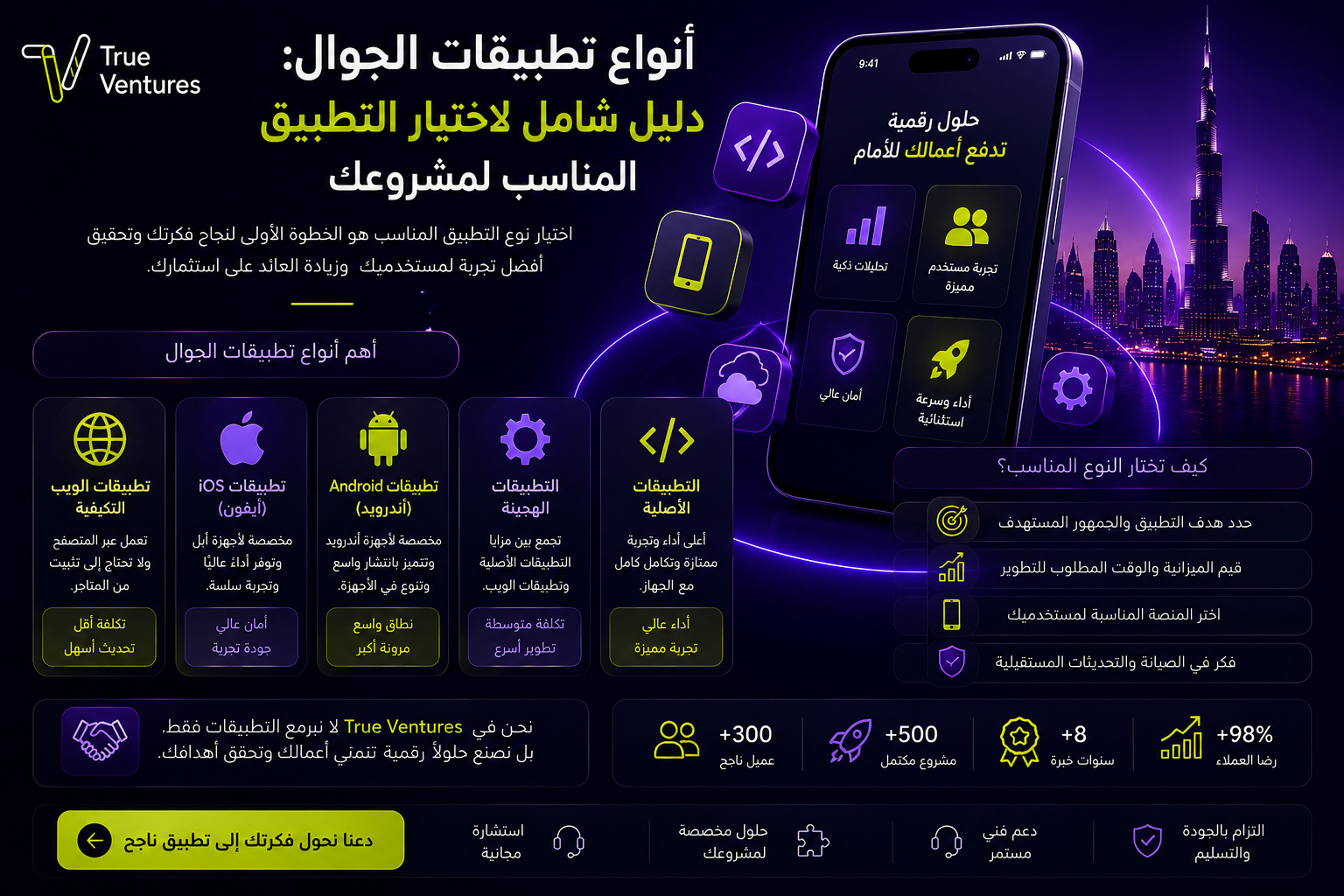
The main types of mobile apps range from business and e-commerce apps to education, entertainment and service apps — and the right choice for your project depends on your target users, the features you need, your budget and how you plan to grow.
A mobile app is no longer just one more channel for reaching customers; in many business models it has become a core part of the product itself. From a single phone, users can shop, pay, learn, book services, communicate, manage their tasks and track their daily activity in minutes.
But the moment you start thinking about mobile app design, one important question comes up: which type of app suits my idea? Do I need a native app, a hybrid app — or would a web app be enough?
In this guide, we walk through the most important types of mobile apps from both a functional and a technical point of view, then explain how to choose the right app and what to look for in a development company.
What Are the Most Common Types of Mobile Apps?
Smartphone apps can be classified in two main ways: by purpose and function, or by the technology used to build the app.
Part One: Types of Mobile Apps by Purpose
1. Social Media Apps
These apps connect individuals and communities and let them share photos, videos, messages and content — think messaging apps and social networking platforms.
Their success depends heavily on ease of use, fast content loading, notifications, security and the ability to handle very large numbers of users.
2. E-Commerce and Shopping Apps
They let users browse products, add them to a cart, pay, track orders and contact the store.
An e-commerce app can be connected to inventory, payment, shipping and customer management systems, turning it into a complete sales channel rather than a simple product showcase.
3. Business and Productivity Apps
These include apps for managing tasks, projects, sales, staff, appointments, reports and more.
The app may serve customers or employees inside the organisation, and it can be integrated with systems such as ERP, CRM and HR so people can reach data and complete actions straight from their phones.
4. Entertainment and Gaming Apps
This category covers games, video and music platforms, streaming and interactive content.
These apps usually demand close attention to performance, responsiveness and user experience. Technical performance directly shapes the experience of Android app users, and Google recommends monitoring stability and performance metrics on an ongoing basis.
5. Educational Apps
They deliver lessons, courses, quizzes and interactive content, and can include student progress tracking, notifications, virtual classrooms and certificates.
Gamification and educational games can also be used to lift engagement and keep learners coming back.
6. Health and Fitness Apps
These help users track workouts, healthy habits and fitness, and some integrate with phone sensors, wearables and smartwatches.
When an app handles sensitive data, designing for privacy and security from day one becomes essential — not a step bolted on after development is finished.
7. Service, Booking and Delivery Apps
This group includes food ordering, ride-hailing, appointment booking, home services and travel apps.
They typically need features such as location tracking, notifications, online payment, ratings and real-time order or service status.
Types of Mobile Apps by Development Approach
The classification above explains what the app does, while the technical classification answers a different question: how will the app be built?
Native Apps
Native apps are built specifically for one operating system, such as Android or iOS, using the tools and technologies designed for that platform.
Their main advantages include:
- High performance and a smooth user experience.
- Deep access to device and operating system features.
- Great flexibility for building complex functionality.
- An experience that feels fully at home on each platform.
Apple’s guidelines make clear that a good app needs a clear interface, intuitive interactions, an easy-to-understand structure and an experience that feels natural on iPhone.
However, building a separate app for each platform can take more time and resources than some cross-platform options.
Hybrid and Cross-Platform Apps
Here, much of the app is built from a shared codebase that runs on both Android and iOS, using technologies such as Flutter.
This approach can be a good fit when your project needs to:
- Reach both Android and iOS users.
- Speed up development.
- Avoid duplicating work across the two platforms.
- Make future updates easier to manage.
Still, the choice between native and cross-platform should never come down to cost alone; it should rest on the nature of the features, the performance you need, the integrations involved and your product’s growth plan.
Web Apps
Web apps run in the phone’s browser and don’t necessarily have to be downloaded from an app store.
They are easy to access and update, and can suit services that don’t rely heavily on the phone’s capabilities.
But they are not the ideal answer for every project — especially when you need deep integration with device features or an experience designed specifically for mobile.
Why Smartphone Apps Matter
The importance of smartphone apps lies in their ability to bring a service closer to the user and make it far easier to reach.
For businesses, an app helps build a direct channel to customers without relying entirely on third-party platforms. It also enables push notifications, a personalised experience and smoother purchasing, booking, payment and follow-up.
An app also makes it possible to collect operational data — with the proper consent and full respect for privacy — that helps the company understand how the product is used and which features users value most.
Most importantly, app quality is not measured by the number of features alone. Google, for example, ties Android app quality to the value delivered to users, the user experience, technical quality, privacy and security.
How to Choose the Right Type of App for Your Idea
Before you choose a technology, start with the problem the app will solve.
Ask yourself: Who will use the app, and what is the one core task they must be able to complete easily?
Then weigh up the following factors:
Nature of the features: if the app needs deep integration with device capabilities or very demanding performance, native may be the right choice.
Target audience: find out the share of Android and iOS users in your target market, and whether you need to launch on both platforms at the same time.
Budget and timeline: a cross-platform solution can be practical for many projects, but the decision should rest on technical analysis, not price alone.
Scalability: ask from the outset what will happen if your user base doubles, or if new services and markets are added.
Security: define what data the app will collect and the level of protection it requires. Android’s guidelines recommend, among other practices, requesting as few permissions and as little data as possible and using secure practices for authentication, communication and storage.
Practical tip: don’t start with a long feature list. Identify the features that deliver your product’s core value, then build a first version you can test and improve based on real usage data.
How to Choose the Right Mobile App Design Company
An app’s success doesn’t depend on the idea alone, but on the technical team’s ability to turn it into a stable, scalable product.
When you are looking for a mobile app design company, check the following:
Technical Expertise
Verify the team’s experience building apps with the technologies your project actually needs — not just how many years the company has been in business.
Project Analysis Before Coding
A good development company doesn’t start writing code straight away. It first understands your business model, audience and processes, then defines the requirements and project scope.
User Experience (UI/UX)
Beautiful design alone is not enough. What you need is a clear user journey that cuts steps and complexity. Apple provides detailed guidelines on layout, typography, accessibility and interaction patterns for building consistent, easy-to-use experiences.
Security and Testing
Ask about performance, security, compatibility and load testing before launch.
Post-Launch Support
Launch is not the end of the project. Bugs, performance and user behaviour must be monitored and improvements released regularly; Android’s own guidelines recommend monitoring performance in production to catch problems and improve the experience.
Understanding Your Business Model
The right technology partner should understand how the app will create value for users and for your company — not just how to build the requested features.
Which Types of Mobile Apps Are Most Used in Business?
The types of mobile apps a business needs vary from sector to sector, but common commercial apps include e-commerce, booking, delivery, customer service, sales team and staff management, learning platforms, loyalty programmes and apps connected to ERP and CRM systems.
No single category is best for every company; a successful app is one that solves a clear problem and gives users a real reason to come back.
Top Reasons Businesses Develop Mobile Apps
Why do companies invest in building their own apps?
Because an app can become a complete channel for serving customers, running operations and driving growth.
It helps make services accessible at any time, improve the customer experience through short, simple journeys, increase engagement with notifications and personalised content, and support digital sales through purchasing, booking and payment.
Internal apps can also help organisations automate procedures, reduce manual work and connect employees to enterprise systems from anywhere.
But the real value comes when results are measured after launch — active users, retention rates, completed transactions, crashes and performance — and that data is turned into continuous improvement.
The Role of Mobile Apps in Work, Education and Entertainment
Mobile apps are now woven into the details of everyday life.
At work, they give employees and managers faster access to tasks, data, customers and operations, and support flexible ways of working.
In education, they make content available anywhere and allow quizzes, videos, exercises and learner progress tracking.
In entertainment, games, video, music and interactive content deliver a personal experience that is available instantly.
That is why, for many companies, the question is no longer simply “Do we need an app?” but rather: which type of app will deliver real value to our users?
From Idea to a Scalable App with True Ventures
Choosing among the types of mobile apps is not a technical decision separate from your project strategy; the wrong technology or an architecture that can’t scale can lead to extra costs down the line.
This is where True Ventures comes in: a Saudi technology company focused on enabling digital transformation for businesses and organisations and turning ideas into operational, scalable digital products.
For mobile app design and development projects, True Ventures follows a methodology that starts with analysis and a study of the business model and users, moves on to user experience and interface design, and then to development using technologies such as Flutter or native, depending on the project’s needs.
Development is followed by performance, security and compatibility testing, then launch, monitoring, support and continuous improvement — all the way to the product growth stage, where new features are added based on data.
The company’s expertise also extends to building systems and digital platforms, ERP, CRM and HR solutions, enterprise and government sector solutions, and growth and digital transformation services.
Turn Your Idea into a Scalable Digital Product
If you have an app idea but aren’t sure whether you need native, Flutter or a web solution, don’t make the technology the first decision in your project.
Start by analysing the idea, the user, the business model and the required features, then choose the technology that serves your product’s long-term goals.
Talk to the True Ventures team about your idea and turn it from an early concept into a practical, secure app built to scale and grow.
The types of mobile apps span social, commerce, business, education, health and entertainment apps, as well as native, hybrid and web apps. Yet a project’s success doesn’t hinge on picking the most popular type, but on choosing the solution that fits your users, business model, budget, and performance and scalability requirements.
Start by understanding the problem you want to solve, define the core features, and choose a technology partner who can bring together business analysis, user experience, development, security and growth.
If you are planning to launch a new app, contact True Ventures and start turning your idea into a digital product designed for growth.
Questions and answers
01What are the different types of mobile apps?
By purpose, mobile apps can be grouped into social media, business, e-commerce, entertainment and gaming, education, health and service apps. Technically, they can be divided into native apps, cross-platform or hybrid apps, and web apps.
02What is the difference between native and hybrid apps?
A native app is built specifically for one platform, while cross-platform solutions reuse a large part of the same codebase to run the app on more than one operating system. The choice between them depends on performance, features, budget and the project plan.
03What is the best type of app for a business?
No single type suits every project. Before choosing the technology, you need to analyse your target audience, the features required, your budget, expected performance, integrations and growth plan.
04Is Flutter a good choice for mobile app development?
Flutter can be a good choice for many projects that target both Android and iOS, especially when sharing one codebase across the two platforms is an important advantage. However, the final decision should be based on the technical requirements.
05Why is user experience important in mobile apps?
User experience determines how easily people can complete tasks in the app, so it directly affects engagement and whether they keep using it. Apple's and Google's guidelines both stress ease of use, performance and design that feels native to the platform.
06How do I know if a mobile app design company is the right fit?
Review its previous projects, its requirements analysis methodology, the experience of its UI/UX and development team, its testing and security procedures, its post-launch support, and its ability to build a scalable product rather than just deliver screens.
Turn this guide into a plan.
Tell us where you are today. Our team will map the next steps with you.
The quickest way
Have a question? Ask us on WhatsApp.
Tell us what you are planning and our team will point you to the right people — no form to fill in.
We usually reply within minutes during working hours.