





How to Build a Mobile Car Wash App with True Ventures
Are bookings slipping through calls and messages? A mobile car wash app organises orders, technicians and payments, and gives customers an easy booking experience that fuels growth.

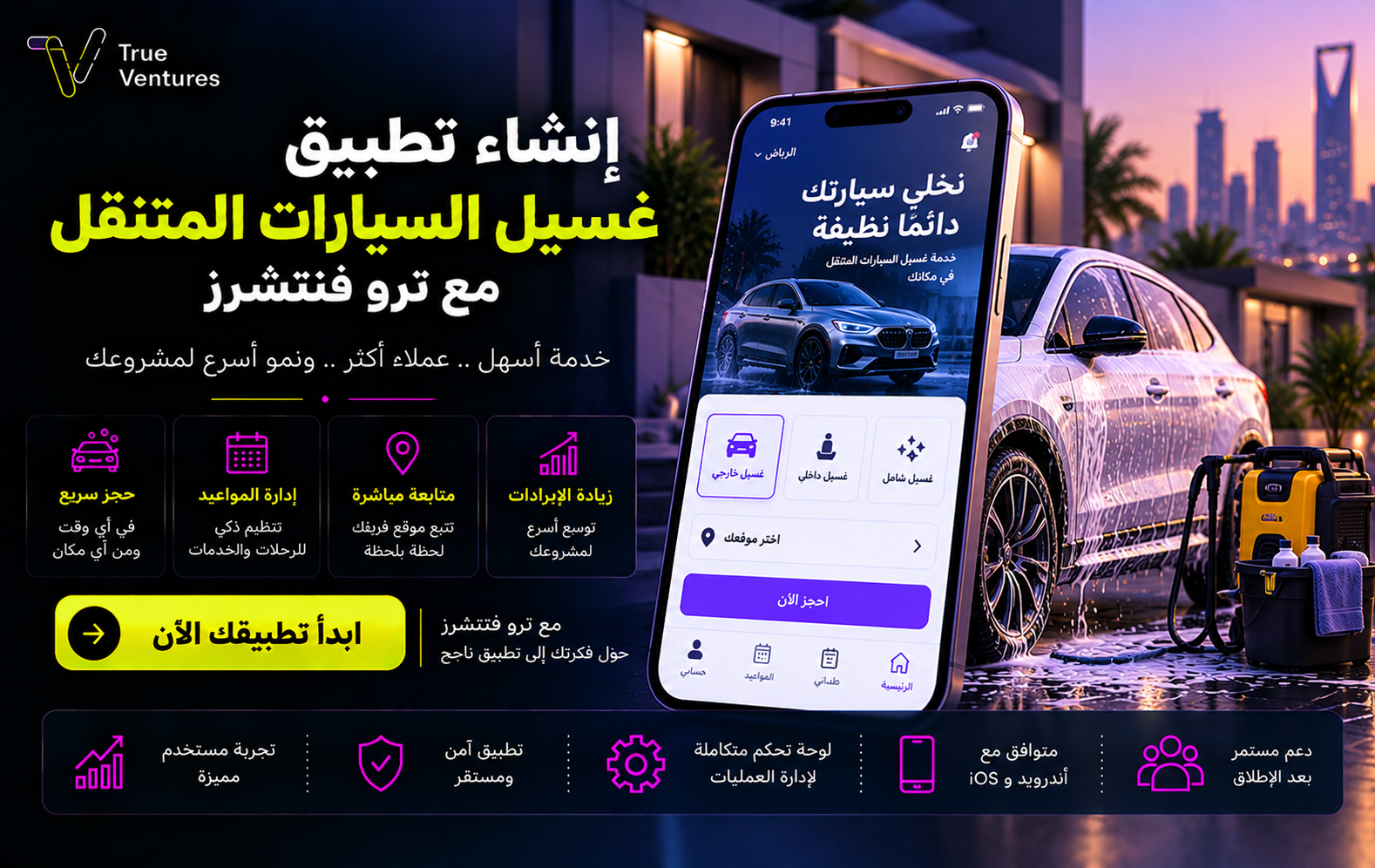
Are your bookings getting lost between phone calls and messages? Building a mobile car wash app organises your orders, technicians and payments, and gives your customers an easy booking experience that helps your business grow with confidence.
What Is a Mobile Car Wash App from a Business Owner’s Perspective?
A mobile car wash app is a digital system that connects customers with your wash team and management, organising the whole service journey from choosing a package and setting a location to carrying out the wash, payment and rating. For a business owner, the app is a tool for running the business and tracking its performance, as well as a channel for receiving bookings.
When building a mobile car wash app, the solution usually consists of three connected parts:
- The customer app: for choosing a service, adding car details, setting a location, booking a slot, paying and tracking the order.
- The technician or field team app: for receiving jobs, viewing service details and the customer’s location, and updating the order status.
- The admin dashboard: for managing packages and prices, organising teams and coverage areas, and tracking orders, payments and ratings.
These parts run on a shared back end and database, so order updates reach the relevant parties according to each user’s permissions.
For example, when a customer books an interior and exterior wash, the system checks that the service is available at their location and at the requested time, then records the booking and allows it to be assigned to the right team. The result is a clear operating cycle you can track and improve.
Why Does Your Business Need a Custom Car Wash App?
Every business delivers its service differently: you may manage your own teams, work with service providers, or target both individuals and companies. That is why custom car wash app design helps you build a system that fits your business model and expansion plans.
Organise Bookings and Reduce Errors:
Relying on calls and messages makes bookings harder to track as orders grow. An app can bring customer, car, service and appointment details together in a single record, reducing the risk of lost details or double-booking the same team.
The success of this feature, however, depends on programming availability rules correctly, accounting for wash duration and travel time between locations.
Make Booking Easy and Encourage Repeat Orders:
Customers want to see services, prices and available slots quickly. With clear interfaces, they can complete a booking without long back-and-forth messages, then reorder later using their saved details.
Recurring packages or loyalty programmes can be added when they suit your business, with clearly stated terms of use.
Track Team Performance and Service Quality:
The system shows the orders assigned to each team, job statuses, late appointments and customer feedback. This data helps management pinpoint problems and make practical decisions about task allocation and training.
Build a Foundation for Expansion:
When you move from serving one neighbourhood to several areas, you need to manage coverage, operational capacity, prices and permissions. Custom development lets you set up these rules from the start or add them gradually.
At True Ventures, mobile app development starts with understanding your business and analysing its requirements, then turning them into a user experience and a scalable system, within a clear scope of work.
Features You Can Build into a Mobile Car Wash App:
Feature choices should reflect what your customers and operations team actually need. It is best to start with the functions that let your business receive an order, fulfil it and collect payment, then expand the app based on usage data.
Account Registration and Car Management:
You can offer simple sign-up with a mobile number, with the option to add more than one car and save its details, such as make, size and special notes.
This information helps the app display the right services and calculate prices according to the rules set by management, and it shortens the steps for repeat bookings.
Displaying Wash Services and Packages:
Customers need to understand what they will get before they book. You can showcase interior and exterior washes, polishing and extra care services, with the contents and approximate duration of each package.
Prices can vary by car category, service or coverage area, with the total amount shown clearly before the order is confirmed.
Location Selection and Coverage Checks:
The app can be integrated with maps to pinpoint the customer’s location, while letting them adjust the meeting point and add instructions, such as a parking bay number or entry gate.
It also helps to check that the location falls within your service area before the booking is completed, so your business doesn’t accept orders it cannot fulfil.
Scheduling Based on Team Capacity:
Booking scheduling goes beyond showing a calendar. The system must take into account the number of available teams, service duration, working hours and travel time.
If a particular service takes longer, the system should reserve a suitable time slot for it rather than treating every service as the same length.
Online Payments and Payment Management:
A suitable payment gateway can be integrated to offer the payment methods it supports, recording each transaction’s status and linking it to the booking.
Good development also handles successful, failed and delayed payment confirmations, and sets out a clear process for cancellations and refunds, so financial issues don’t become a burden on customer service.
The Technician App and Order Status Updates:
The technician app can show daily jobs, the customer’s location, car details and the service required. It lets technicians update the status to: job accepted, on the way, work started, service completed.
Live team tracking is an additional feature that requires you to decide how it works, its permissions and its impact on battery life and privacy.
Notifications and Ratings:
Notifications help confirm bookings, send appointment reminders and inform customers when their order status changes. Once the service is complete, you can collect their rating and feedback and link it to the order and the team responsible.
The value lies in using feedback to improve the service and handling complaints through a clear process within management.
Admin Dashboard and Operational Reports:
You can develop an admin dashboard that lets you:
- Manage services, prices and coverage areas.
- Add staff and set their permissions.
- Assign jobs and track bookings.
- Review payments and cancellations.
- Measure completed orders, average order value and repeat bookings.
These metrics help you understand performance, provided they are clearly defined and you choose the data that supports your business decisions.
How Long Does It Take to Build a Mobile Car Wash App?
The time it takes for building a mobile car wash app depends on the number of interfaces, the scale of features, the integrations required and how clear the requirements are. That is why the timeline is set after analysing the project, and it should never be treated as a fixed duration for every app.
At True Ventures, delivery moves through the following stages:
1. Project Analysis and Requirements Documentation:
This stage starts by defining the target audience, operating areas, how teams are managed, and the services, prices and booking policies.
The requirements are then documented to make clear what the app and admin dashboard will include and to reduce unplanned changes during development.
2. UX and Interface Design:
The booking flow is designed from choosing a service through to confirmation, with interactive prototypes prepared for review before coding begins.
This stage covers the customer, technician and admin interfaces, with careful attention to Arabic language support, clear buttons and ease of use on mobile screens.
3. Development and Technical Integration:
The apps and back end are developed, then the required integrations are implemented, such as maps, payments and notifications.
Flutter may be a good fit for building Android and iOS apps from a shared codebase, while other requirements may call for native development. The approach is chosen based on the project’s needs, without assuming that any one technology is always best.
4. Testing and Launch:
Testing covers the booking journey, appointment clashes, payment scenarios, user permissions and performance on the target devices.
The publishing requirements are then prepared. Development time should be kept separate from app store review, since publishing requires submitting the build and its details for review before it becomes available to users.
To make delivery smoother, set your first-version priorities early: booking, job management, payments and the admin dashboard. Additional features can be planned once real-world operations have been tested.
True Ventures’ Experience Building a Mobile Car Wash App:
The True Ventures portfolio includes Satea Car Services, a project in the car services sector that features in the company’s portfolio. According to the project information provided, it relates to washing and polishing services.
Projects like this matter because they turn a field service into a digital experience that customers understand and business owners can manage.
When planning a similar project, the development company needs to understand the relationship between the service, the appointment, the location and the team responsible, then translate that relationship into operating rules within the app.
The True Ventures methodology is built on business analysis, UX design, development and testing, then launch, follow-up and optimisation. This gives business owners a clear path to build their product and develop it step by step.
To see how well this experience fits your idea, you can discuss your project requirements with the team and ask to see related work and how it was delivered.
Start Building Your Mobile Car Wash App with True Ventures
A successful app starts with understanding your business: how it receives orders, allocates jobs, delivers the service and keeps customers’ trust. When these details are translated into a clear system, technology becomes a tool that helps you manage and grow.
Here at True Ventures, we bring together business analysis, UX design and mobile app and systems development to deliver solutions that match your project’s needs and ambitions.
Questions and answers
01How much does it cost to build a mobile car wash app?
The cost depends on the project scope: the customer and technician apps, the admin dashboard, features and integrations, and design and testing requirements. Operating costs, such as hosting, third-party services and maintenance, should also be calculated separately and clearly.
02Can a car wash app be launched on both Android and iPhone?
Yes. You can choose cross-platform or native development after assessing the required features, budget and maintenance plan.
03Do I need a separate app for technicians?
If you manage several teams and field jobs, a technician app can help organise delivery. For a small business, a simpler interface can be considered at first, depending on how it operates.
04Can I add monthly car wash subscriptions?
Yes, by defining the number of washes, the validity period, the booking method and cancellation terms. If subscriptions renew automatically, customer consent and the payment and cancellation process must be made clear.
05Can a car wash app expand to new cities?
Management of cities, coverage areas, teams and prices can be built in, provided the system takes each area's operational capacity into account before opening bookings there.
06What happens after the car wash app launches?
The app needs monitoring for bugs and performance, technical updates and improvements based on usage. It is important to agree on the scope of support and maintenance, ownership of the code and accounts, and the project handover process.
Turn this guide into a plan.
Tell us where you are today. Our team will map the next steps with you.
The quickest way
Have a question? Ask us on WhatsApp.
Tell us what you are planning and our team will point you to the right people — no form to fill in.
We usually reply within minutes during working hours.